
The Attributes of Knowledge
How Human Consciousness Provides for Our Needs, Wants, and Desires
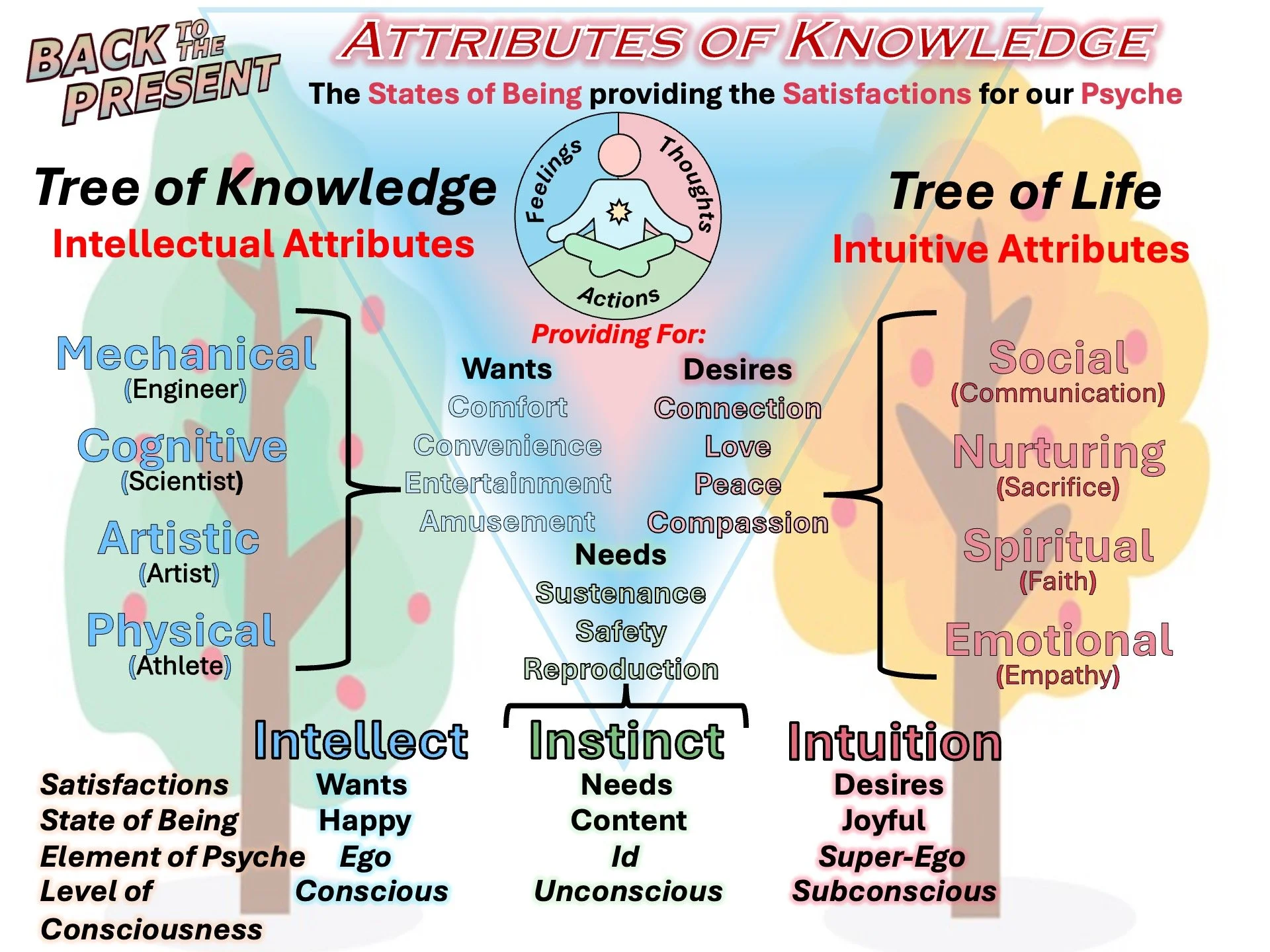
Human beings are equipped with three complementary sources of knowledge—instinct, intellect, and intuition. Each source provides distinct provisions that satisfy different layers of the human psyche and shape how we experience life.
These sources are not in competition. They are developmental, relational, and meant to function in balance.
Instinct — The Foundation of Survival
(Unconscious • Id • Contentment • Needs)
Instinct represents the most fundamental form of knowledge shared across all living beings. It operates beneath conscious awareness and exists to ensure survival.
Instinct provides for our needs, including:
Sustenance (food, water, physical survival)
Safety (protection, shelter, threat avoidance)
Reproduction (continuation of life)
When instinctual needs are met, the emotional state that follows is contentment.
There is no excess here—only sufficiency. Instinct answers the question:
“Am I alive, safe, and sustained?”
Intellect — The Tree of Knowledge
(Conscious • Ego • Happiness • Wants)
Intellect is the human capacity to learn, design, build, analyze, and create within the material world. It is expressed through four intellectual attributes:
Physical (the Athlete)
Artistic (the Artist)
Cognitive (the Scientist)
Mechanical (the Engineer)
Together, these attributes allow humans to transform the environment and improve efficiency, comfort, and experience.
Intellect provides for our wants, including:
Comfort
Convenience
Entertainment
Amusement
When these wants are satisfied, the emotional state that follows is happiness.
Happiness is real, meaningful, and valuable—but it is temporary and ego-centered.
Intellect answers the question:
“How can I improve my experience of the world?”
Intuition — The Tree of Life
(Subconscious • Superego • Joyfulness • Desires)
Intuition is humanity’s most relational and morally guided source of knowledge. It governs how we understand one another, extend loving intention, and create meaning beyond ourselves.
It is expressed through four intuitive attributes:
Social (Communication)
Nurturing (Sacrifice of time and energy)
Spiritual (Faith)
Emotional (Empathy)
These attributes do not improve objects or systems—they improve people.
Intuition provides for our desires, including:
Connection
Love
Peace
Compassion
When these desires are fulfilled, the emotional state that follows is joyfulness—a deeper, more enduring state of being that arises from healthy relationships and shared meaning.
Intuition answers the question:
“How do my actions, feelings, and thoughts affect others—and who am I becoming because of that?”
Why Balance Matters
Modern society has excelled at cultivating intellectual mastery, often at the expense of intuitive development.
We train athletes, artists, scientists, and engineers—
but too often neglect to teach:
how to communicate honestly,
how to empathize responsibly,
how to sacrifice wisely,
how to live with faith in loving intention.
When intellect grows without intuition, humanity becomes advanced—but disconnected.
When intuition is honored alongside intellect, humanity becomes better to one another.
The Human Aim
The acquisition of knowledge is not merely about progress or productivity.
It is about using our spiritual gift of thought to contribute something meaningful to the collective human experience.
Instinct keeps us alive.
Intellect makes life easier.
Intuition makes life worth living.
And presence—Back to the Present—is where all three can be used wisely.
If you’d like, next we can:
tighten this into a homepage button version
create a 60–90 second narrated script
adapt it for adolescents
or map it directly to a classroom lesson or reflection exercise
Just tell me where you want it to live.