
The Shaping of Human Identity
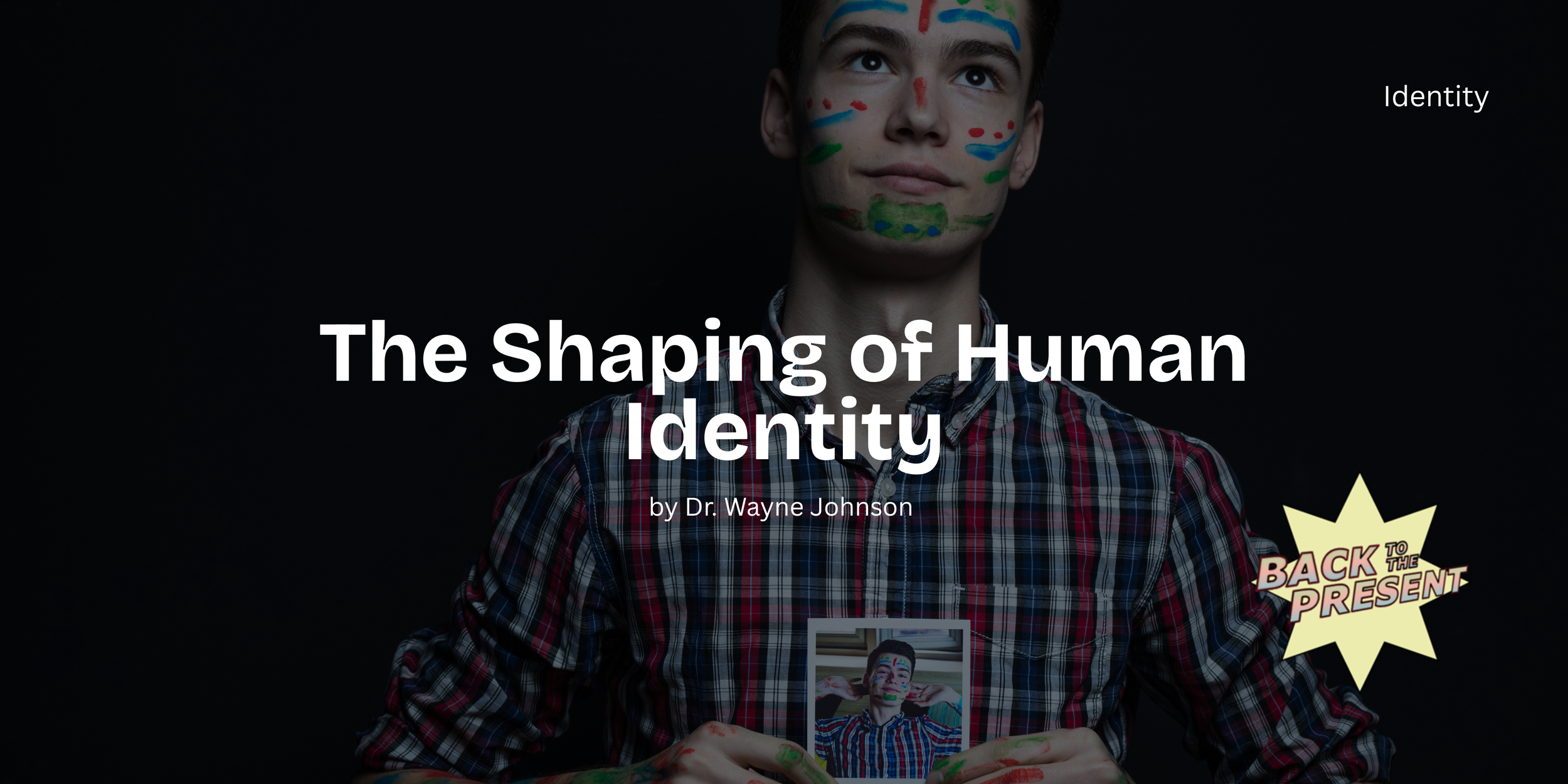
Through the Principles of Back to the Present
We live in a world increasingly obsessed with Identity — not just a little obsessed, but full-time, overtime, emotionally exhausting, "let me check how people reacted to my post before I decide how I feel about myself today" obsessed.
People spend enormous amounts of time and energy trying to figure out who they are, how they are perceived, whether they matter, where they belong, and why their hair looked better yesterday than it does today.
Some build Identity around intelligence, achievement, appearance, athleticism, creativity, or wealth. Others quietly build Identity around rejection, ANXIETY, loneliness, shame, or fear.
But beneath all of those identities is a deeper question:
Who are we when the applause stops?
Identity is the description of how we see ourselves in this world, and how we believe other people see us. It is partly our inner story, and partly the story we think everyone else is writing about us. Most of us assume other people are writing much longer reviews than they actually are.
Whether we realize it or not, every human being is constantly building an internal story about who they are, what gives them value, how they fit into the world around them, and whether they are doing life correctly — as if there were an instruction manual we all misplaced at birth.
Yet despite living in the most technologically advanced civilization in human history, many people today feel more emotionally overwhelmed, disconnected, anxious, and uncertain about themselves than ever before.
Why?
Because modern society has become extraordinarily skilled at developing human achievement while often neglecting human awareness. We can send rockets into space, map the human genome, and order dinner from a phone. But many people still struggle to sit quietly with their own thoughts for three minutes without needing a snack, a screen, or a minor life crisis.
Within the LIFE-MAP of Back to the Present (BTTP), Identity is not viewed as something fixed. Identity is something we continuously shape through the conscious and unconscious use of our time and energy — through our actions, feelings, and thoughts. Every conversation. Every relationship. Every reaction. Every intention.
We are always becoming someone. The question is whether we are becoming that person consciously.
The Three Sources of Knowledge
BTTP teaches that human Identity develops through three major Sources of Knowledge: instinct, intellect, and intuition. Each source influences what we seek, how we think, how we relate, what satisfies us, and ultimately who we become.
These three sources are constantly interacting within human consciousness. Sometimes they work together beautifully. Sometimes they behave like three people trying to share one steering wheel.
Instinct says, "Protect me." Intellect says, "Let me analyze this for seven hours." Intuition says, "Maybe try love, humility, and not sending that text right now."
Understanding this internal struggle may be one of the most important steps toward understanding ourselves.
Instinct — The Survival Self
At the foundation of human Identity is instinct. This level is associated with our needs, contentment, the unconscious, and the drive toward productivity. Its purpose is survival.
Instinct asks: Am I safe? Am I protected? Am I fed? Will I survive?
This part of Identity is shared with all living creatures — a hungry child crying for food, a person instinctively pulling away from danger, a baby clinging to a parent. At this level, Identity is immediate and reactive.
Most human beings still spend a surprising amount of life operating primarily from this level of consciousness, especially during moments of fear, anger, sadness, temptation, uncertainty, stress, or emotional threat. When we feel threatened, we often stop asking, "What is the loving and wise response?" and start asking, "How do I protect myself right now?" That reaction is human. But it is not always helpful. Especially in traffic.
The Body’s Built-In Alarm System
When instinct senses danger, the body does not begin with a calm committee meeting. It begins with an alarm.
The autonomic nervous system shifts into action. The sympathetic division prepares the body for survival by activating the familiar stress response often described as fight, flight, or freeze. The heart may beat faster. Breathing may become shallow. Muscles may tighten. Digestion may slow down. The body may release stress chemicals, including adrenaline and cortisol, to prepare for immediate action.
This response is not a character flaw. It is a survival system. The vagus nerve, which is deeply involved in communication between the brain and body, plays an important role in helping regulate the body’s internal state. When the stress response is activated, the balance between sympathetic arousal and parasympathetic regulation can become disrupted.
That is why stress is never just "in your head." Stress is also in your chest, your stomach, your breathing, your muscles, your sleep, your tone of voice, and sometimes in the text message you should probably not send until tomorrow.
This is where the F.A.S.T. emotional states become so important in BTTP. Fear, anger, sadness, and temptation often ignite the survival self:
Fear says, "Protect yourself."
Anger says, "Defend yourself."
Sadness says, "Withdraw and protect the wound."
Temptation says, "Escape the discomfort right now."
Each one can activate the body before wisdom has time to enter the room. The body tightens before the mind explains. The voice rises before the heart reflects. The impulse appears before intention has been chosen.
This is the survival self doing what it was designed to do: keep us alive. But the same system that helps an animal escape a predator can cause a human being to overreact to criticism, rejection, disappointment, or uncertainty. The body may respond as if there is a lion in the room when the actual threat is a difficult conversation, a disappointed look, or a social media comment.
BTTP does not shame this instinctive response. It teaches us to become aware of it.
Once we recognize that our body has entered survival mode, we can pause and return to the present moment through the Obligations:
Awareness: "My body is reacting."
Challenge: "Is this truly danger, or is this discomfort?"
Patience: "Can I give myself a moment before I respond?"
Honor: "Can I acknowledge what is real without letting impulse take control?"
This is how conscious awareness and free choice begin to regulate instinct. The goal is not to eliminate the stress response — we need it. The goal is to recognize when the survival system is protecting us from real danger, and when it is trying to run our relationships and our Identity from an old alarm bell that no longer needs to be ringing.
In BTTP, this is where Decision Making begins. The body may offer the impulse. But the present moment gives us the chance to choose the intention.
Reflective Question
When life becomes difficult, do you notice yourself becoming reactive instead of intentional?
Gentle Reminder
Pause before reacting. Take one breath. Ask yourself: "Am I responding from instinct, or am I choosing with conscious awareness?"
The Tree of Knowledge — Intellectual Identity
As human beings grow, they begin developing intellect. While instinct is driven largely by the unconscious need for survival, intellect gives us a more conscious explanation for why we do what we do.
This is where civilization expands. This is where humanity learns to imagine, analyze, compete, perform, create, invent, organize, and build. The Tree of Knowledge represents humanity’s Intellectual Attributes — the tools that help us shape the world outside of us.
BTTP does not reject intellect. Human progress depends upon it. The issue is not that humanity has developed intellectual power. The issue is that intellectual power often develops faster than emotional and intuitive maturity.
When that happens, we become very good at achieving, producing, consuming, and displaying, but not always very good at being peaceful, responsible, compassionate, or whole. We learn how to improve the world around us before we learn how to understand the world within us.
The Four Intellectual Attributes
The Tree of Knowledge expresses itself through four major Intellectual Attributes: physical, artistic, cognitive, and mechanical. Each one gives humanity a powerful way to interact with the world. Each one can also become a fragile foundation for Identity when a person begins to believe, "This ability is the whole of who I am."
Physical Identity (Athlete)
Some people develop Identity through physical capability — strength, appearance, coordination, athleticism, discipline, and performance. We admire athletes because physical excellence reflects commitment, sacrifice, competition, and mastery of the body.
Physical ability is beautiful and worthy of respect. But when a person’s entire Identity depends upon appearance or performance, insecurity often follows aging, injury, or loss of validation. A person who only knows themselves through the body may feel lost when the body changes. And the body does change — it starts with one mysterious knee sound and eventually becomes a full committee meeting every time you stand up.
Physical Identity is valuable. But it cannot carry the whole weight of who we are.
Artistic Identity (Artist)
Others develop Identity through creativity, imagination, beauty, and expression. The writer captures imagination through story. The painter awakens visual perception. The musician moves us through sound. Artists help humanity feel — they give language, color, sound, and form to things people often feel but cannot explain.
But artistic Identity can become fragile when self-worth depends upon admiration, approval, or recognition. The ego loves applause. The problem is that applause is a terrible short-term tenant in your mind: it arrives loudly, leaves quickly, and rarely pays the rent on inner stability.
The deeper question becomes: "Do I know who I am without the audience?"
Cognitive Identity (Scientist)
Some people shape Identity through knowledge and understanding — logic, learning, intelligence, analysis, and problem solving. Scientists, physicians, scholars, philosophers, and thinkers help humanity understand reality more deeply. They challenge assumptions, organize knowledge, and move us from confusion toward understanding.
But cognitive Identity can quietly become attached to the belief: "My value comes from what I know." Knowledge without emotional awareness can become cold. Knowledge without humility can become arrogance. Knowledge without loving intention can become manipulation. A person can know many facts and still struggle to be kind. A person can win every argument and still lose connection.
Mechanical Identity (Engineer)
Some people develop Identity through building, organizing, designing, and implementing systems in the physical world. This Identity grows through engineering, systems thinking, invention, construction, and technical skill. Mechanical Identity helped humanity create cities, infrastructure, transportation, and modern technology. Engineers make ideas functional.
But mechanical Identity can become limited when a person begins to see every problem as something to fix, control, optimize, or redesign. Not every wound is a machine. Not every relationship is a system failure. Not every emotional difficulty can be solved with a spreadsheet, although many of us have tried.
When mechanical thinking is disconnected from intuition, it may build efficient systems that do not serve human peace, connection, or compassion. That is the danger of intellectual power without intuitive guidance.
How Intellect Serves Our Wants
The intellect is one of humanity’s most extraordinary offerings because it helps us improve the quantity and quality of the conditions of life. That question — "How can life be made easier, faster, safer, more efficient?" — has produced medicine, transportation, communication, homes, schools, businesses, art, science, and technology. That is real progress.
Within BTTP, however, intellect is closely connected to our wants. Our wants seek comfort, convenience, entertainment, and amusement. These satisfactions are not wrong. Comfort helps us rest. Convenience saves time and energy. Entertainment can lift the spirit.
The problem begins when we ask temporary satisfactions to create lasting happiness. They cannot. The comfortable chair eventually becomes ordinary. The new phone eventually becomes slow. The exciting purchase eventually becomes clutter. The applause eventually becomes memory.
This is the great loop of ego-driven wants. The ego looks for happiness through what it can accomplish, acquire, or receive from others. It is temporarily fed by accomplishment ("Look what I did"), acknowledgement ("Look who noticed"), and acquisition ("Look what I have"). For a moment, the ego feels satisfied. But the feeling does not last. Soon it begins looking again — something else to achieve, something else to buy, something else to prove.
This is why wants can become insatiable. They keep moving the finish line. That does not mean accomplishment is bad, acknowledgement is meaningless, or acquisition is immoral. It means they are unstable foundations for Identity. When Identity depends on feeding the ego, happiness becomes temporary, conditional, and fragile.
The Emotional Cost of the Tree of Knowledge Alone
Modern society increasingly teaches people to define themselves through what they achieve, own, display, or consume. Social media has intensified this dramatically. Young people are often taught to brand themselves before they fully understand themselves.
A teenager today may receive more comparison, validation, rejection, entertainment, and public feedback in a single day online than previous generations experienced in months. It is like handing a young person a mirror, a scoreboard, a popularity contest, a shopping mall, and a public performance review all at once. Then we wonder why they feel anxious.
Yet despite unprecedented stimulation and connection, ANXIETY continues rising, loneliness continues rising, emotional instability continues rising, and identity confusion continues rising.
Why? Because external achievement alone cannot fully stabilize human Identity. A person may become wealthy, admired, successful, and accomplished — and still feel disconnected, anxious, or purposeless. Civilization has advanced technologically faster than emotionally. We have learned how to achieve. But many people have not learned how to be at peace.
The Tree of Knowledge can help us create better conditions for life. But by itself, it cannot create lasting joyfulness. For that, intellect must be guided by intuition. Achievement must be guided by loving intention. When intellect serves only the ego, we keep chasing temporary happiness. When intellect serves loving intention, it becomes wisdom in action.
Reflective Question
If your achievements disappeared tomorrow, who would you still believe yourself to be?
Gentle Reminder
Let achievement serve Identity, but do not let achievement become Identity.
The Tree of Life — Intuitive Identity
BTTP teaches that human beings also develop through the Tree of Life. This side of Identity is not primarily about external capability. It is about relational wisdom — learning how to use our Intuitive Attributes to develop connection, love, peace, and compassion through loving intention.
This is the part of Identity that asks: How do I love well? How do I respond with wisdom? How do I use my time and energy for others? How do I become someone who brings peace into relationships?
The Four Intuitive Attributes
Spiritual Attribute — Faith
Learning how to have faith in ourselves and others allows us to be at peace with ourselves and others. Faith allows human beings to move beyond fear toward peace.
This does not mean pretending life is easy, or saying "Everything happens for a reason" when what someone really needs is compassion. Faith means trusting that loving intention still matters, even when life is uncertain. It is the ability to believe in the possibility of good within ourselves and others.
Nurturing Attribute — Sacrifice
Learning how to sacrifice our time and energy for others allows us to love. A nurturing person asks, "How can I help someone become better?" rather than, "What can I get from them?" This is one of the deepest shifts in human Identity: moving from self-centered survival toward conscious love.
True sacrifice is not enabling — it is not rescuing people from every consequence while quietly building resentment and calling it kindness. Sacrifice is the loving use of our time and energy to help another person grow. That requires wisdom. Sometimes love says yes. Sometimes love says no. Sometimes love says, "I believe in you too much to do this for you."
Social Attribute — Communication
Learning how to communicate allows us to genuinely connect with one another. True communication is far more than talking. It includes reading facial expression and body language, listening, understanding, honesty, presence, and emotional safety.
Communication is not simply waiting for the other person to stop talking so we can reload our point. It is not winning the argument while losing the relationship.
A child often learns communication not from instruction, but from observation. They learn how to speak to others by watching how others speak to them — tone, patience, whether disagreement is safe, whether love becomes louder under stress or deeper.
Emotional Attribute — Empathy
Learning how to empathize with others allows us to extend compassion to one another. Empathy transforms Identity from self-centered awareness into shared human awareness. It says, "Your experience matters to me." Not, "I fully understand everything you are feeling because I once had a vaguely similar Tuesday."
Real empathy is humble. It listens before it explains. It notices before it judges. It enters another person’s emotional world without trying to take over the furniture.
Intuitive knowledge develops largely through observing emotional experiences in others. A child learns empathy by witnessing compassion. A child learns peace by observing peace. A child learns emotional instability by living within emotional instability. Identity is constantly being shaped by observation. Children are always watching — and they notice everything, including the exact tone we hoped they would not repeat later in public.
The Desire for Meaning
The Tree of Life is where Identity begins seeking connection, love, peace, compassion, and meaning. BTTP teaches that joyfulness emerges when Identity aligns with loving intention.
Not temporary pleasure. Not constant stimulation. Not endless achievement. But deeper alignment between what we believe, how we live, and how we treat other people.
We are surrounded by stimulation, yet starving for meaning. We have more ways to be entertained than ever before, but many people still feel unseen, unknown, and unloved. This is why Identity cannot be fully formed through achievement alone. Identity needs relationship. Identity needs responsibility. Identity needs loving intention.
Reflective Question
What brings you temporary happiness… and what brings you lasting joyfulness?
Gentle Reminder
Notice the difference between what entertains you for a moment and what helps you become more loving, peaceful, and whole.
The Great Human Imbalance
One of the central insights of BTTP is that modern society heavily develops the Tree of Knowledge (intellect) while often neglecting the Tree of Life (intuition).
We teach children how to compete, how to perform, how to produce, how to achieve, and how to succeed intellectually. But far less often do we teach them emotional regulation, empathy, sacrifice, self-love, communication, peace, or conscious awareness.
As a result, many people become intellectually capable while emotionally overwhelmed. They learn how to succeed externally, but not always how to stabilize themselves internally. They may know how to build a résumé, but not repair a relationship. They may know how to calculate interest, but not resolve resentment. They may know how to win a debate, but not sit quietly with sadness.
This imbalance contributes profoundly to modern ANXIETY. We are not lacking information. We are often lacking integration.
Identity Is Formed Through Repetition
BTTP teaches that Identity is not shaped by isolated moments. Identity is shaped through repeated patterns of actions, feelings, and thoughts. Every repeated emotion, behavior, and response strengthens Identity.
A person who repeatedly lies becomes deceptive. A person who repeatedly shows empathy becomes compassionate. A person who repeatedly chooses awareness over impulse develops emotional maturity.
Identity is not accidental. Identity is practiced. We become what we repeatedly choose — not perfectly, not instantly, but gradually. Choice by choice. Response by response. Moment by moment.
The Role of Fear, Anger, Sadness, and Temptation
BTTP teaches that fear, anger, sadness, and temptation can pull us away from the present moment. When these emotional states dominate consciousness, impulsive decisions increase, relationships destabilize, ANXIETY rises, and self-awareness weakens.
This is why BTTP emphasizes the Obligations: awareness, challenge, patience, and honor. These help restore presence and conscious Identity formation.
Awareness helps us notice what is happening.
Challenge helps us question whether our reaction is wise.
Patience gives us space to choose.
Honor helps us acknowledge reality without running from it, reshaping it, or pretending the problem is entirely everyone else’s fault.
Together, these Obligations help us return to the present moment, where conscious awareness and free choice become available again.
The Highest Development of Identity
The ultimate goal of BTTP is not perfection. That is good news, because perfection remains unavailable, overpriced, and emotionally exhausting. The goal is alignment.
The healthiest Identity develops when intellectual knowledge and intuitive wisdom work together — when achievement serves purpose, intelligence serves compassion, power serves responsibility, and knowledge serves loving intention. Identity becomes integrated rather than fragmented.
This is where a person becomes not only capable, but grounded. Not only intelligent, but wise. Not only successful, but peaceful. Not only admired, but loving.
Perhaps the greatest challenge of human life is not discovering what we can achieve. It is discovering who we become while pursuing it. Because achievement without loving intention can inflate the ego. But achievement guided by loving intention can serve humanity.
That is the difference between building a life that looks impressive and building a life that actually brings joyfulness.
Final Reflection
At the end of life, most people will not primarily be remembered for their possessions, their accomplishments, their appearance, or their achievements. They will be remembered for how they made others feel, how they loved, how they responded during difficulty, and how they used their time and energy.
In BTTP, Identity is ultimately the living story created through the conscious and unconscious use of our actions, feelings, and thoughts in the present moment.
The question is not simply: "Who am I?"
The deeper question may be: "Who am I becoming?"
And is that person becoming more present, more peaceful, more compassionate, more responsible, and more capable of loving intention?
Because every day, through our actions, feelings, thoughts, time, and energy, we are writing the story of our Identity. The hope of BTTP is that we learn to write that story with awareness, challenge, patience, honor, and loving intention.
And maybe, along the way, with enough humility to laugh at ourselves. Because if we cannot laugh at ourselves occasionally, life will usually assign someone else to do it for us.