
Exploring Human Identity: Intellectual and Intuitive Partnerships
INTELLECTUAL AND INTUITIVE PARTNERSHIPS
Human identity is expressed through eight core attributes: four Intellectual Attributes and four Intuitive Attributes. We use them to understand ourselves, evaluate others, solve problems, form relationships, and decide how to invest our time and energy. Each may be strengthened through experience, but no single attribute tells the whole story of who we are.
The central challenge is balance. Intellect gives us the capacity to imagine and build. Intuition helps us direct those abilities with loving intention. When they operate in partnership, our identity can serve both personal growth and the well-being of others.
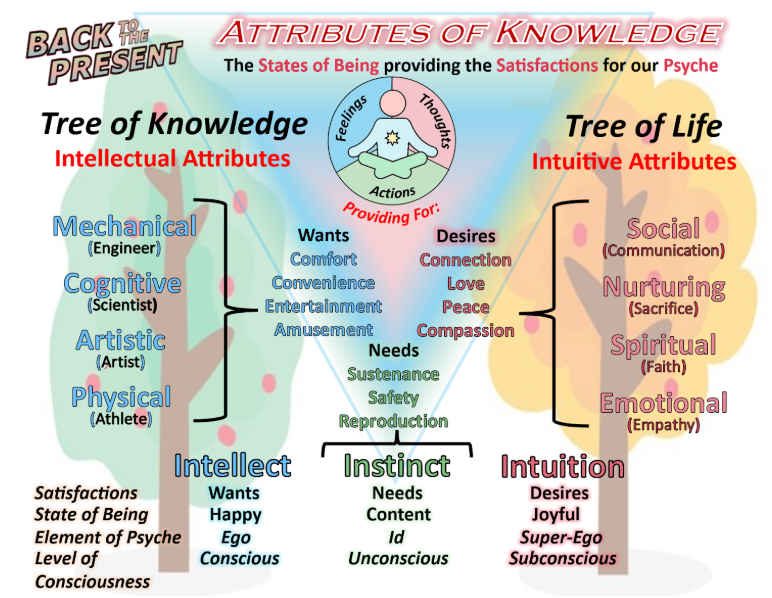
Figure 1-Attributes of Our Identity
The Nature of Our Instinctual Attributes:
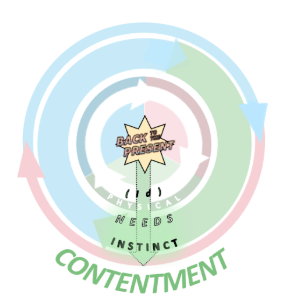
Contentment taps into our primal needs. It’s the Emotional State of Being that arises when our physical necessities—food, shelter, and safety—are met. Rooted in the id, which governs our basic instincts, contentment provides a steady, and calming presence that anchors us. Unlike the thrill-seeking nature of happiness, contentment provides a steady, calming presence that anchors us. reminds us of what is enough, offering stability and gratitude for what we already have (Figure 2- How our Instincts provide us with Contentment).
Example: Enjoying a quiet evening with friends, laughing and sharing stories, can evoke this profound sense of contentment.
Reflective Question: What is one thing you can do today to cultivate contentment in your life?
The Manifestation of Intellectual Attributes:
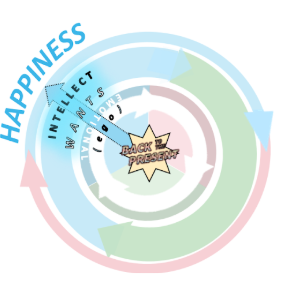
Humanity has tirelessly used its Intellectual Attributes—Physical, Artistic, Cognitive, and Mechanical—to create and innovate in the pursuit of satisfying our ego’s endless wants. This pursuit has been driven by the desire to achieve the emotional state of happiness, often equated with material comfort, convenience, entertainment, and amusement. However, this relentless drive has not come without consequences (Figure 3-How our Intellect Provides us with Happiness).
How Intellectual Attributes Have Served the Ego:
1. Physical
Athletes and fitness experts have developed sports, training regimens, and health sciences that not only entertain but also cater to the ego’s longing for peak physical performance. From professional sports leagues to personal fitness apps, these innovations have created industries dedicated to optimizing and showcasing human physicality.
Support: Engaging in physical activities not only enhances bodily health but also improves cognitive functions. Regular motor activity has been shown to bolster cognitive abilities in both healthy individuals and those experiencing cognitive decline.
Example: The global obsession with competitive sports, fitness challenges, and body image reflects how physical attributes are tied to ego-driven aspirations.
Reflective Question: How much of our pursuit of physical perfection serves a deeper purpose versus satisfying superficial wants?
2. Artistic
Artistic endeavors have created endless streams of music, movies, visual art, and performances designed to evoke awe and joy. Yet, the consumption of art has often shifted from appreciation to indulgence.
Support: Artistic endeavors, such as visual arts, play a crucial role in mental and physical well-being. They involve complex perceptual, cognitive, and motor functions, suggesting a shared neural basis that contributes to learning and development.
Example: The rise of streaming platforms offering limitless entertainment options demonstrates how art has been commodified to keep us constantly amused.
Reflective Question: How often do we pause to truly experience and reflect on art, rather than simply consuming it for temporary distraction?
3. Cognitive
Scientific discoveries and technological advancements have solved problems and answered questions that were once unimaginable. Yet, these advances also enable convenience-driven lifestyles that cater to the ego’s need for instant gratification.
Support: Cognitive functions encompass a range of mental processes, including memory, attention, and problem-solving. These processes are fundamental to how individuals perceive and interact with the world, forming a core component of personal identity.
Example: Smartphones have revolutionized communication, but they have also tethered us to a constant flow of notifications, overwhelming our consciousness.
Reflective Question: Are our cognitive achievements freeing us, or are they creating dependencies that hinder deeper contentment?
4. Mechanical
Engineers and inventors have created systems and tools to simplify our lives and increase productivity. From transportation to household appliances, mechanical ingenuity has drastically improved our quality of life but has also contributed to an overwhelming number of choices, otherwise known as decision fatigue.
Support: Technical skills, often associated with mechanical abilities, are linked to bodily-kinesthetic-spatial intelligence. This form of intelligence involves the capacity to manipulate objects and fine-tune physical movements, which is essential in fields requiring technical expertise. Ultimately, this intellectual attribute allows us to see how things fit together to operate.
Example: Cars, planes, and smart home devices make life easier but can overwhelm us with choices.
Reflective Question: What choices in your life could you simplify to reduce stress and decision fatigue?
The Consequences of Overwhelming Choice
As humanity’s Intellectual Attributes have manifested in the creation of countless innovations, we’ve entered an era where choice itself has become a source of ANXIETY (See Sources of ANXIETY. The ego’s insatiable desire for more—more options, more luxury, more convenience—has inundated our consciousness with decisions. Instead of enhancing happiness, this abundance often leaves us paralyzed or dissatisfied.
Example: The paradox of choice in consumer goods, such as deciding between hundreds of smartphone models, can lead to decision fatigue and a perpetual feeling of discontent.
Reflective Question: How can we simplify our lives by focusing on what truly brings us contentment rather than chasing endless options?
A Call to Reflect
What drives our relentless pursuit of innovation? Are we creating tools that serve humanity, or are we serving the ego’s endless wants?
How can we realign our Intellectual Attributes to focus on purpose, peace, and productivity rather than indulgence?
What role does conscious awareness play in determining whether our creations bring true joy or simply temporary satisfaction like happiness?
By examining these questions, we can begin to understand how our Intellectual Attributes can be used not only to serve the ego but also to improve our quality of life with meaningful progress. The challenge lies in balancing the gifts of our intellect with the wisdom of our intuition, ensuring that our creations uplift humanity rather than overwhelm it.
How Intuitive Attributes Foster Collaboration and Joy
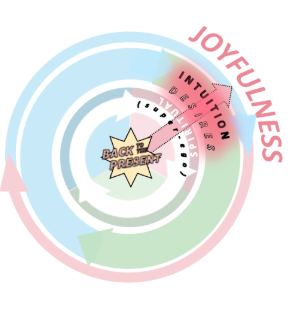
Humanity’s Intuitive Attributes—social, nurturing, spiritual, and emotional—have been instrumental in allowing us to work together to pursue the satisfaction of what we desire for the super-ego (Figure 4-How our Intuition Provides us with Joyfulness). These attributes not only foster cooperation but also enable us to bring joy into our lives by understanding and practicing the art of loving intention as outlined in the TOOLBOX FOR A JOYFUL LIFE (*Figure 5-TOOLBOX FOR A JOYFUL LIFE).
1. Social Intuition
Our ability to communicate effectively serves as the cornerstone of collaboration. Beyond words, we’ve developed intricate tools for expression—mannerisms, facial expressions, and body language—that allow us to share feelings and thoughts on a deeper level. These forms of communication transcend language, enabling us to convey meaning and intention in ways that connect us profoundly to one another.
This remarkable ability has empowered us to elevate our other Intuitive Attributes, taking them far beyond the basic survival needs they fulfill in other species. Through our social intuition, we’ve created systems to share intellectual knowledge, advancing both the quantity and quality of life. It’s this very foundation that has allowed us to innovate, cooperate, and collectively progress.
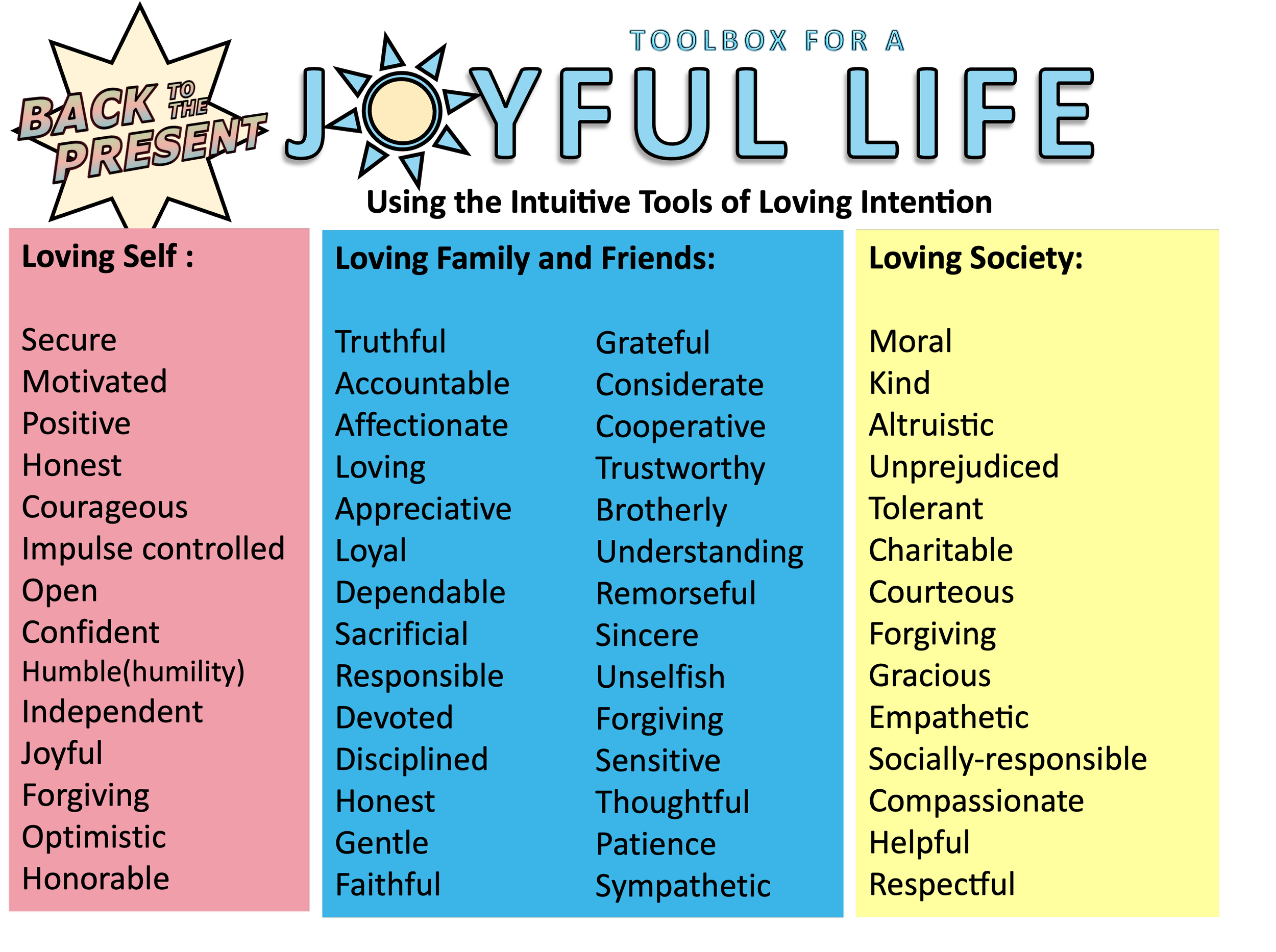
Figure 5-Toolbox for a Joyful Life
Communication, as a social attribute, is not just a tool for survival—it’s a profound mechanism for forging meaningful connections that drive humanity forward.
Support: Studies indicate that strong social connections are crucial for psychological well-being. Engaging in meaningful social interactions enhances communicative skills and contributes to a positive self-concept.
Example: The development of global networks, such as the internet, exemplifies how our ability to communicate enables us to pool knowledge and resources for the greater good.
Reflective Question: How can we further harness our social intuition to build stronger, more empathetic connections and collaborations?
Application:
Social Attribute-Communicate: with authenticity and understanding: Through honest and meaningful communication, using the tools of loving intention we built clarity and bridge divides, fostering deeper connections and collaboration.
Example: Imagine resolving a conflict with a roommate by sitting down for a candid conversation, ensuring both perspectives are heard and respected.
2. Nurturing Intuition
The capacity to sacrifice time and energy to nurture and support others is one of humanity’s most profound expressions of loving intention. Unlike other animals, whose nurturing often revolves solely around meeting basic needs, human nurturing extends far beyond survival. In the animal kingdom, a wolf, for instance, nurtures its young only until they can fend for themselves. Once they are self-sufficient, instinct dictates that they leave the pack.
Human nurturing, however, encompasses a deeper, more intentional commitment. We don’t nurture to simply meet physical needs—we invest emotionally, spiritually in helping others grow, thrive, and succeed. This nurturing often continues well beyond the point of independence, forming lifelong bonds and fostering environments of care and growth.
Support: The concept of nurturing, which involves caregiving and selflessness, is linked to prosocial behavior. Studies have shown that engaging in nurturing activities can enhance one's sense of purpose and identity, reinforcing the importance of sacrificial abilities in personal development.
Example: A parent’s dedication to a child’s education and emotional well-being often extends into adulthood, ensuring their long-term success and happiness.
ReflectiveQuestion: How can we embrace our nurturing attribute to better support others while maintaining balance in our own lives?
Application:
To Nurture-sacrificing time and energy for the well-being of others: Sacrifice is a powerful expression of love and commitment, demonstrating our willingness to invest loving intention into the growth and success of those we care about.
Example: Helping a friend prepare for a big interview, even when you’re busy, shows nurturing through time and effort.
3. Spiritual Intuition
Faith provides us with a belief in one another and the shared values that guide humanity. This belief forms the foundation of moral and ethical standards, ensuring that we use the tools of loving intention effectively. Unlike the instinctual faith observed in animals—such as trust within a pack to meet survival needs—human faith extends far beyond basic necessity. It becomes a source of individual and collective purpose, offering a comforting sense of direction and encouraging us to act with integrity and hope.
This spiritual connection fosters resilience and unity, especially in challenging times. It allows us to persevere and rebuild, trusting in the collective strength of humanity to overcome obstacles.
Support: Research has explored the structure and content of adults' sense of spiritual identity, analyzing how spirituality contributes to one's overall sense of self. This includes examining the role of spirituality in providing meaning and purpose in life.
Example: Acts of collective faith, such as communities coming together to rebuild after natural disasters, showcase the power of shared spiritual intuition.
Reflective Question: How does faith—in ourselves, others, or a higher purpose—shape our decisions and actions?
Application:
Maintain Spiritual-faith in our shared humanity and the tools of loving intention: Faith inspires us to see beyond mere survival, allowing us to believe in and find meaning and purpose in our collective efforts to uplift one another.
Example: Joining a volunteer group that works to address food insecurity in your community reflects faith in humanity’s ability to create positive change.
4. Emotional Intuition
Empathy, one of the most profound Intuitive Attributes, allows humans to deeply connect with others by understanding and sharing their experiences. Unlike animals, whose empathy is primarily instinctual and focused on meeting survival needs, human empathy transcends the immediate and practical. While a wolf may show empathy by caring for a pack member to ensure the group’s overall survival, humans use empathy to forge complex emotional and social bonds that enrich life beyond basic necessities.
Human empathy enables us to anticipate the needs of others, comfort them in emotional distress, and act with genuine compassion. This elevated understanding creates opportunities for collaboration, innovation, and profound relationships, helping us to achieve goals that benefit not just individuals but entire communities.
Support: Empathy is a key component of emotional intelligence, which has been associated with better interpersonal relationships and mental health. Research indicates that individuals with higher empathic abilities tend to have a more nuanced understanding of others' emotions, contributing to more effective communication and social harmony.
Example: A teacher dedicating extra time to help a struggling student or a friend providing emotional support during a crisis exemplifies the depth of human empathy.
Reflective Question: How can we expand our empathetic understanding to foster stronger connections and promote collective well-being?
Application:
Practice Emotional-empathy to foster meaningful connections: Empathy allows us to truly understand and resonate with others’ experiences, creating a foundation for loving intention to bring compassion and mutual support.
Example: Offering emotional support to a peer who’s feeling overwhelmed with schoolwork or life pressures builds deeper trust and connection.
The Art of Loving Intention
The TOOLBOX FOR A JOYFUL LIFE offers a wealth of actionable tools that empower us to channel our IntuitiveAttributes into creating a better world. These tools are inherent within each of us, waiting to be accessed. While many aspire to embody these qualities, it often takes observation and self-awareness to awaken them from the depths of our subconscious mind (*Figure 5-TOOLBOX FOR A JOYFUL LIFE). When we observe others practicing loving intention, it can inspire us to embody these qualities ourselves, as such individuals often exude joy and positivity.
By occupying our consciousness with these intentions, we can purposefully direct our emotions, behaviors, and responses. Practicing communication, faith, sacrifice, and empathy enables us to nurture the collective growth of the human spirit. These tools transform our interactions, strengthen relationships, and contribute to a more harmonious world.
When we leverage these tools, our actions, feelings, and thoughts align with the higher intentions of the super-ego. This alignment transcends self-serving wants, allowing us to build a world that is more joyful, compassionate, and interconnected.
Reflective Question: How can we use the tools of loving intention to create more meaningful, positive impacts in our daily lives?
A Call to Reflect
How masterful our intellect has proven, our creative ability to take energy, and over time, mold it into virtually anything we can imagine. Interestingly, this only works when balanced with the intuitive knowledge of loving intention. If we would like to manifest the best version of ourselves and contribute that to the world we live in, we had better become more responsible with our time and energy. While our intellect has provided us the attributes to manifest anything we can imagine, we can no longer afford to neglect the intuitive attributes that can protect what is best for all that exists.
How can we better balance our Intuitive Attributes and Intellectual Attributes to foster collective well-being?
In what ways can the art of loving intention be practiced in our daily lives to bring joy to ourselves and others?
How can we ensure that our pursuit of desires serves not only our super-ego but also humanity as a whole?
By embracing and refining these attributes, we can move beyond the limitations of the ego to experience deeper joy and fulfillment, both individually and collectively.
Closing Reflection
In our pursuit of intellectual achievements, we have neglected the essential teaching of intuitive tools—empathy, compassion, and purpose. The allure of our intellectual creations—Modern conveniences, material comforts, endless entertainment, and limitless amusement—has blinded us to the importance of nurturing our intuitive gifts. This neglect has contributed to the rise in ANXIETY and disconnection, particularly among children, who now face overwhelming pressures in an increasingly complex world.
To address this, we must transform our education system. By integrating mindfulness practices, emotional intelligence training, and opportunities for creative collaboration into the curriculum, we can equip children with the tools they need to navigate life with clarity and purpose. Schools should prioritize fostering a balance between intellectual pursuits and intuitive attributes—encouraging self-awareness, emotional regulation, and interpersonal connection alongside academic achievement.
Only by restoring this balance can we create a future where humanity thrives not just materially, but emotionally and spiritually as well.