
Two Ways of Knowing: An Ancient Insight, A Modern Confirmation
This image represents one of the most enduring truths about human consciousness: there are two distinct ways of knowing, emerging from a single human center.
Long before psychology, neuroscience, or anatomy, our ancestors recognized that human awareness does not operate through one channel alone. They observed, through lived experience, that we come to know the world in two fundamentally different ways—one through analysis and mastery, and another through relationship and meaning. These ways of knowing were not described in technical language, but expressed symbolically, most famously through the Tree of Knowledge and the Tree of Life.
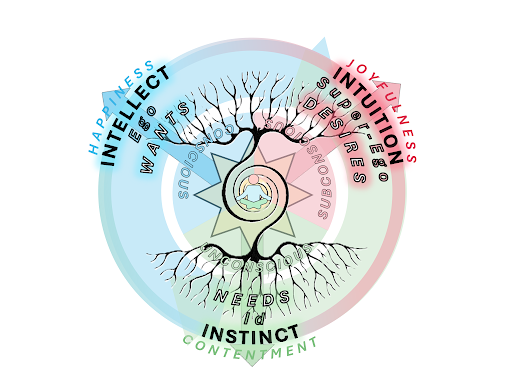
The image before you is a modern translation of that ancient insight.
The Way of Intellect — The Tree of Knowledge
On one side of the image, Intellect rises upward from our shared instinctual roots. This way of knowing is concerned with understanding, categorizing, measuring, and improving the conditions of life. It allows us to plan, build, invent, and solve problems. Through intellect, we learn how things work and how to make them work better.
This is the domain of wants—comfort, convenience, efficiency, and progress. When these wants are met, we experience happiness. Intellect is closely associated with the ego and the conscious level of awareness, where choice becomes deliberate and directed.
Symbolically, this is the Tree of Knowledge:
the tree that grants power through understanding.
The Way of Intuition — The Tree of Life
On the other side of the image, Intuition rises in parallel, drawing from the same roots but branching toward a different purpose. This way of knowing is relational rather than analytical. It is how we sense meaning, connection, love, peace, and compassion. Through intuition, we understand one another, not by measurement, but by presence.
This is the domain of desires—connection, love, peace, and compassion. When these desires are fulfilled, we experience joyfulness. Intuition is associated with the superego and the subconscious level of awareness, where values, conscience, and loving intention guide our choices.
Symbolically, this is the Tree of Life:
the tree that sustains meaning, relationship, and continuity.
One Root, Not Two Minds
Crucially, the image shows that intellect and intuition are not separate beings, nor competing forces. They arise from the same human foundation—our instinctual awareness of needs and survival. The trunk is shared. The life force is the same.
Problems arise not because one way of knowing exists, but when one grows without the other.
Intellect without intuition becomes power without compassion.
Intuition without intellect becomes care without effectiveness.
Creativity, peace, and human flourishing emerge only when these two ways of knowing remain in relationship.
Ancient Wisdom, Modern Confirmation
Our ancestors did not know brain anatomy as we do today, but they clearly recognized two distinct ways of knowing. Modern neuroscience has since found that these ways of knowing often correlate with left–right hemispheric tendencies, giving biological support to ancient symbolic wisdom.
Importantly, this does not mean the brain is strictly divided, nor that one side is “better” than the other. Rather, it suggests that the symbolic truths encoded in ancient stories were grounded in lived human experience, which science is now beginning to describe in biological terms.
What was once told through story is now echoed through research.
Why This Matters Now
In a world that increasingly rewards speed, productivity, and technical mastery, the Tree of Knowledge has grown tall. But without equal care for the Tree of Life, ANXIETY rises, relationships fracture, and creativity loses its purpose.
This image reminds us that the path forward is not the rejection of intellect, but its guidance through intuition—through communication, empathy, faith, and sacrifice. It is through this balance that knowledge is shared, creativity spreads, and humanity moves forward together.
This is not a new truth.
It is an ancient one—now remembered, refined, and made visible again.