
Reclaiming Eden: A Mindful Interpretation of Genesis through the Attributes of Identity
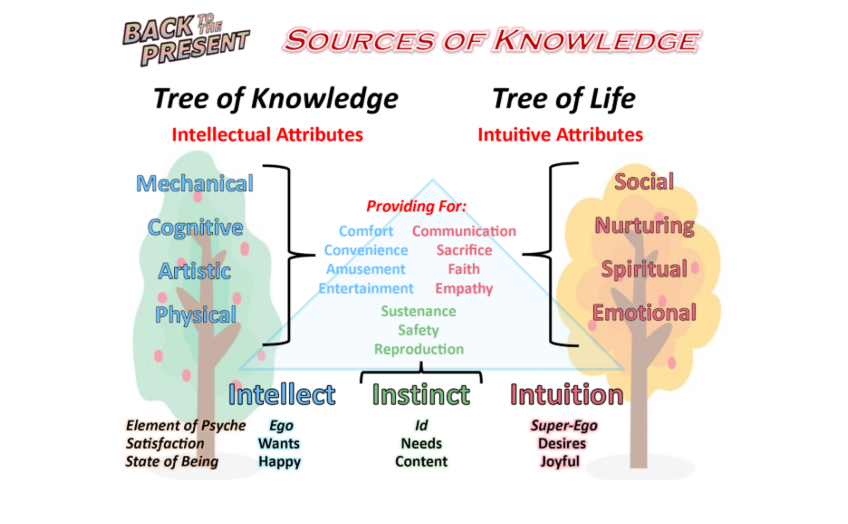
The Biblical story of Genesis has long served as a powerful metaphor for the human condition, reminding us of the origins of our unique conscious awareness and free choice. At its center are two trees: the Tree of Knowledge and the Tree of Life. This modern reinterpretation, illustrated through the image titled "Attributes of Identity" from backtothepresent.org, uses these same trees to symbolize the development of human awareness. In this model, the trees do not merely represent temptation and eternal life, but the duality of human growth through our unique access to knowledge, in the form of our instincts, intellect, and intuition.
This framework helps us understand our inner division and how to reintegrate the self by honoring our physical, emotional, and spiritual Gifts, our time and energy (Limited Resources), and our ability to align actions, feelings, and thoughts (Manifestations) with loving intention.
The Tree of Knowledge: The Awakening of Intellect
On the left side of the image stands the Tree of Knowledge, a representation of the Intellectual Attributes: mechanical, cognitive, artistic, and physical. These capacities empower us to manipulate, invent, and improve the world around us, generally to improve our quantity and quality of life. With them, we created modern life—infused with comfort, convenience, amusement, and entertainment. These are expressions of the ego, seeking to fulfill wants and experience happiness.
This mirrors the Genesis narrative: when Adam and Eve eat the fruit, "the eyes of both were opened" (Genesis 3:7), symbolizing the birth of conscious awareness and the dawn of intellect, and the choices it could and would create. With this awakening came the knowledge of alternatives, the burden of choice, and the complexity of wants versus needs. While intellect expanded our capacities, it also introduced ANXIETY, discontent, and disconnection from the present moment. We began to occupy our consciousness with objectives that became uniquely suited for humanity.
The pursuit of intellect alone is not evil, but unbalanced, it draws us away from contentment and the simple satisfaction of our needs, into endless craving that our ego experiences when introduced to what it is we want.
The Tree of Life: The Voice of Intuition
Opposite the Tree of Knowledge is the Tree of Life, standing for the Intuitive Attributes: social, nurturing, spiritual, and emotional. These are the faculties of the super-ego, guiding us toward desires aligned with deeper purpose—joyfulness rather than fleeting happiness.
While the Tree of Knowledge emphasizes control and progress, the Tree of Life invites surrender, connection, and wisdom. It honors communication, sacrifice, faith, and empathy and as sacred tools—offering a path to relational harmony, purpose, and spiritual alignment.
In the Genesis account, Adam and Eve are exiled not because they sought knowledge, but because they misused their Unique Abilities—conscious awareness and free choice—to reject divine presence. The Tree of Life, protected after the fall, remains the symbol of integration and return. In this model, we understand it as the access point to living with loving intention. The Tree of Life would expose us to the knowledge that would come from living our life with loving intention, as described in the Toolbox for a Joyful Life (Figure 2-Toolbox for a Joyful Life)
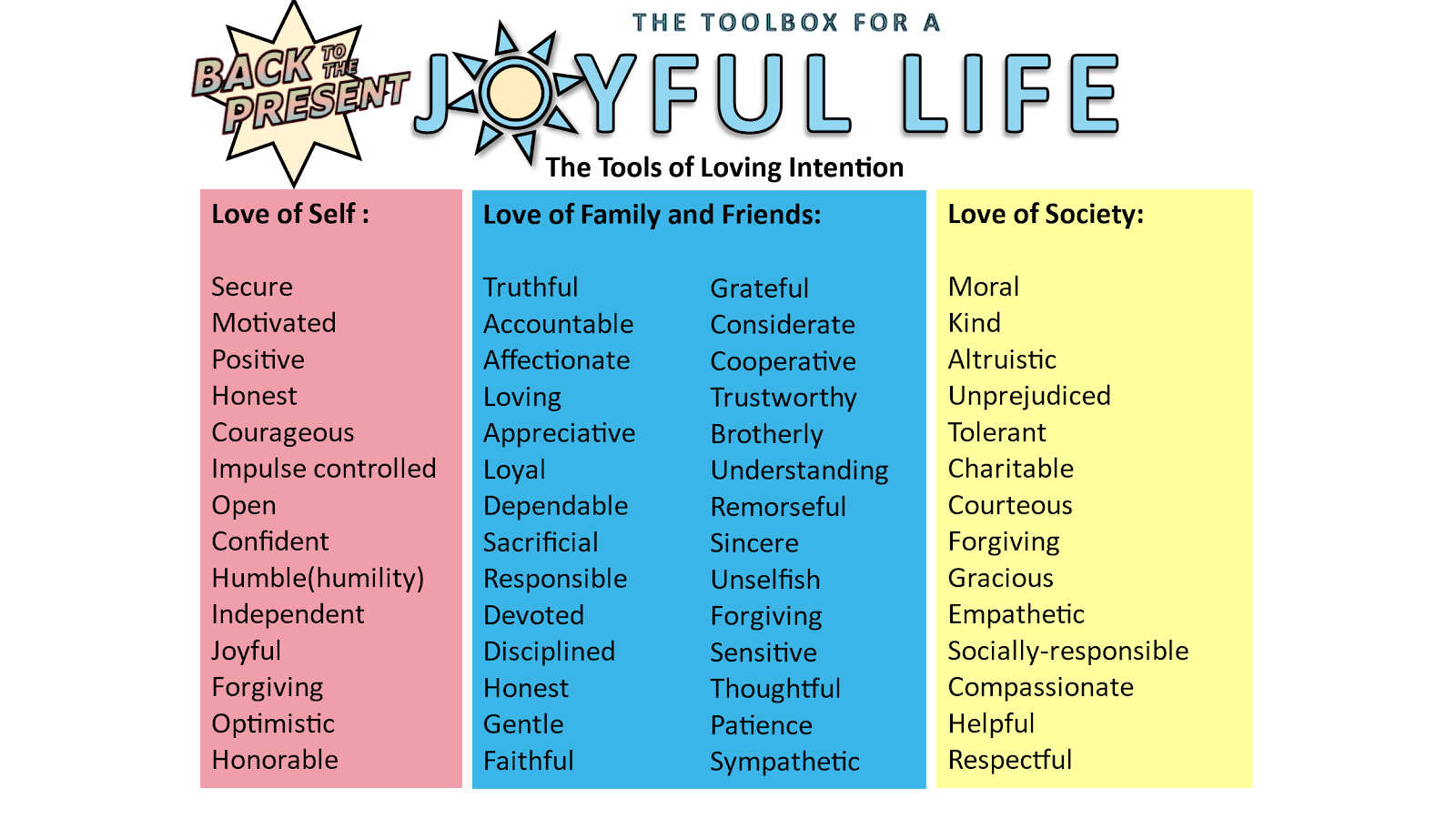
Figure 2-Toolbox for a Joyful Life
The Biblical story of Genesis has long served as a powerful metaphor for the human condition, reminding us of the origins of our unique conscious awareness and free choice. At its center are two trees: the Tree of Knowledge and the Tree of Life. This modern reinterpretation, illustrated through the image titled "Attributes of Identity" from backtothepresent.org, uses these same trees to symbolize the development of human awareness. In this model, the trees do not merely represent temptation and eternal life, but the duality of human growth through our unique access to knowledge, in the form of our instincts, intellect, and intuition.
This framework helps us understand our inner division and how to reintegrate the self by honoring our physical, emotional, and spiritualGifts, our time and energy (Limited Resources), and our ability to align actions, feelings, and thoughts (Manifestations) with loving intention.
The Tree of Knowledge: The Awakening of Intellect
On the left side of the image stands the Tree of Knowledge, a representation of the Intellectual Attributes: mechanical, cognitive, artistic, and physical. These capacities empower us to manipulate, invent, and improve the world around us, generally to improve our quantity and quality of life. With them, we created modern life—infused with comfort, convenience, amusement, and entertainment. These are expressions of the ego, seeking to fulfill wants and experience happiness.
This mirrors the Genesis narrative: when Adam and Eve eat the fruit, "the eyes of both were opened" (Genesis 3:7), symbolizing the birth of conscious awareness and the dawn of intellect, and the choices it could and would create. With this awakening came the knowledge of alternatives, the burden of choice, and the complexity of wants versus needs. While intellect expanded our capacities, it also introduced ANXIETY, discontent, and disconnection from the present moment. We began to occupy our consciousness with objectives that became uniquely suited for humanity.
The pursuit of intellect alone is not evil, but unbalanced, it draws us away from contentment and the simple satisfaction of our needs, into endless craving that our ego experiences when introduced to what it is we want.
The Tree of Life: The Voice of Intuition
Opposite the Tree of Knowledge is the Tree of Life, standing for the Intuitive Attributes: social, nurturing, spiritual, and emotional. These are the faculties of the super-ego, guiding us toward desires aligned with deeper purpose—joyfulness rather than fleeting happiness.
While the Tree of Knowledge emphasizes control and progress, the Tree of Life invites surrender, connection, and wisdom. It honors communication, sacrifice, faith, and empathy and as sacred tools—offering a path to relational harmony, purpose, and spiritual alignment.
In the Genesis account, Adam and Eve are exiled not because they sought knowledge, but because they misused their Unique Abilities—conscious awareness and free choice—to reject divine presence. The Tree of Life, protected after the fall, remains the symbol of integration and return. In this model, we understand it as the access point to living with loving intention. The Tree of Life would expose us to the knowledge that would come from living our life with loving intention, as described in the Toolbox for a Joyful Life (Figure 2-Toolbox for a Joyful Life)
The Bridge Between: Instinct as Foundation
Between the two trees lies a central triangle labeled Instinct, representing the id and our fundamental biological drives: sustenance, safety, and reproduction. This domain is neither intellectual nor intuitive—it is primal, the exhibited for of knowledge of all living species.
In early Genesis, this state corresponds to life before the fall—where instinct alone guided behavior, and needs were met without conflict. But as humans developed intellect and intuition, we became capable of choice, vision, and moral reasoning.
The real challenge is not choosing one tree over the other but integrating all three levels—instinct, intellect, and intuition—into a cohesive Identity.
The Return to Presence: Uniting the Trees Within
Rather than a story of sin and punishment, Genesis—when viewed through this framework—is a story of spiritual evolution. The image teaches us that we’ve overdeveloped intellect while neglecting intuition, and in doing so, have lost touch with the joy found in the present moment.
By honoring our physical, emotional, and spiritual gifts and using our time and energy wisely, we can realign our actions, feelings, and thoughts with both our needs, wants, and desires. We achieve this through awareness, challenge, patience, and honor—our Obligations—which restore balance and support our deeper Agreements of productivity, peace, and purpose.
This is the modern Eden—not a place, but a state of mindful unity where intellect and intuition dance in harmony. A place where loving intention rules, and where the human spirit is free to be content, happy, and truly joyful.
Conclusion
The "Attributes of Identity" image offers a spiritually rich and psychologically grounded lens for viewing Genesis. It honors the human journey not as a fall from grace, but as an opportunity to reclaim grace through balance—of brain and heart, intellect and intuition, ego and super-ego.
In doing so, we do not simply return to Eden. We become it.
Let us walk again, back to the present—and rediscover the joy that has always been ours to claim.