
The Birth of Human Consciousness: From Instinct to Creative Evolution
For millions of years, life on Earth evolved slowly, shaped by the push and pull of the environment. Reptiles survived through instinct, driven by unconscious reflexes that met their most basic needs. Mammals added something more: consciousness, a state of being awake and alert, capable of emotional expression and cooperation. But humanity’s story carried an even greater leap, a moment when consciousness grew into Awareness.
This Awareness was unlike anything evolution had seen before. We became capable of reflecting on the past and anticipating the future. We realized that our time and energy were Limited Resources, and that every choice carried consequences, not only for ourselves, but for others. This moment marked the birth of Unique Abilities: conscious Awareness and free choice. Humanity had begun its journey into creative evolution.
Neuroscience suggests that consciousness evolved to solve decision-making problems where instinct alone was insufficient (Grinde, 2024; Gusev, 2025). This aligns with the idea that our Awareness of time and energy as Limited Resources propelled us into free choice.
Reflective Question: When did you first become aware that your choices affected not only you but also the lives of others around you?
Exercise:
Mindfulness Prompt: Take three deep breaths and reflect on one choice you made in the last 24 hours. Visualize the ripple effect it may have had on others.
Journaling Prompt: Write about a moment when you realized your actions influenced someone else’s feelings, positively or negatively.
The Foundations: Three Streams of Human Intelligence
At the core of conscious decision-making, we can observe three interconnected streams of human intelligence that flow together in our daily choices, these I refer to as Sources of Knowledge:
Instinct - Our automatic responses and deeply embedded patterns that help us navigate basic needs—finding nourishment, seeking safety, protecting those we care about. When these foundational needs are met, we often experience a sense of contentment and groundedness.
Intellect - Our capacity to analyze, learn, and solve problems consciously. This analytical ability allows us to expand beyond basic survival, creating innovation, comfort, and pursuing our ambitions. It drives our wants and our conscious pursuit of improvement and happiness.
Intuition - Our ability to rapidly synthesize complex information, including emotional wisdom, values, and subtle patterns we may not consciously recognize. This often guides us in matters of empathy, faith, meaningful sacrifice, and authentic communication, helping us connect with what brings deeper fulfillment or joy into our lives.
How They Work Together
Rather than operating as separate systems, these three Sources of Knowledge blend and interact in nearly every choice we make. A single decision often draws simultaneously from automatic responses (instinct), conscious analysis (intellect), and intuitive sensing. For example, choosing how to respond to a friend in distress might involve instinctive care responses, intellectual problem-solving, and intuitive understanding of what they truly need.
Research reveals the complexity of human decision-making beyond conscious analysis. Derek Denton (2006) describes primordial emotions—early, non-reflective feelings like thirst, hunger, and breathlessness—as foundational to our survival responses, showing how much of our basic functioning operates below conscious awareness. Studies of the adaptive unconscious confirm that much of our decision-making happens outside deliberate thought (Wegner & Bargh, 2006).
This research suggests that our non-conscious processing is both ancient and sophisticated, though it operates differently from what we might call intuitive wisdom. While our automatic responses handle survival needs efficiently, the kind of intuition that guides us toward empathy, meaningful connection, and values-based choices appears to emerge from the complex interplay of our emotional intelligence, accumulated experience, and conscious reflection—representing an integration of multiple systems rather than a single, ancient wisdom source.
Using This Framework
This three-stream model can serve as a practical guide for reflection and conscious choice-making. By learning to notice these different aspects of our intelligence, we can make decisions that honor not only our survival needs but also our deeper sense of meaning and purpose. This helps us use the knowledge to fulfill what we want and desire as well.
Reflective Question: In your daily decisions, can you notice how instinct, intellect, and intuition blend together? How might paying attention to all three streams help you make choices that feel more aligned?
Exercise:
Awareness Activity: Over the course of one day, write down three decisions you make. Rather than labeling each as purely instinctual, intellectual, or intuitive, notice how all three streams may have influenced each choice. What did you sense automatically? What did you think through consciously? What felt right at a deeper level?
Classroom Version: Students can share examples of decisions and explore together how multiple streams of intelligence contributed to their choices, recognizing the complexity of human decision-making.
The Role of Memory: A Profound Gift
What enabled humanity's leap into conscious awareness was our sophisticated ability to store and integrate knowledge across time. While many animals possess remarkable memory capabilities—elephants remembering drought locations across decades, dolphins recognizing companions after years apart, corvids planning for future needs—human memory appears to have developed distinctive qualities that shape our experience of time and choice.
Our memory systems work in interconnected ways:
Explicit memory allows us to consciously recall and analyze past experiences, building knowledge that can be shared and expanded upon
Implicit memory stores patterns, emotions, and intuitive wisdom that guide us beneath conscious awareness
How Memory Transforms Our Intelligence Streams:
Memory allows our instinctive responses to become more sophisticated, as we learn from experience rather than relying solely on genetic programming
Memory enables our intellectual capabilities to build cumulatively, creating the foundation for culture, science, and civilization through shared knowledge across generations
Memory nurtures our intuitive wisdom, storing the emotional truths and relational patterns—empathy, faith, meaningful sacrifice, and authentic communication—that continue to inform our choices
The Gift of Temporal Awareness
What may be particularly distinctive about human memory is our acute awareness of time's passage and energy's limits. This consciousness of temporal scarcity—knowing that our time and energy are finite resources—appears to influence how we store, recall, and use memories to guide our choices.
Through memory, we experience continuity: linking past experiences to present decisions and future possibilities. Research confirms that memory is central to human consciousness because it bridges past and future, enabling our sense of continuous selfhood (Kotchoubey, 2018).
Reflective Question: What is one memory that continues to guide your choices today, even if you aren't always conscious of its influence?
Exercise:
Mindfulness Prompt: Close your eyes and bring to mind a memory that brings you peace or strength. Notice how your body responds (calmness, tension release, warmth).
Journaling Prompt: Write a short reflection: How does this memory guide my present decisions?
The Human Dilemma of Choice
With this Gift came a burden: choice. Unlike other animals, humans were no longer bound by instinct alone. We could pause, reflect, and decide. But the more choices we faced, the more anxious we became.
Too often, our intellect tempted us with wants: comfort, convenience, entertainment, and amusement, at the expense of what truly mattered. When our needs, wants, and desires became confused, we lost our emotional confidence, drifting into indecision and ANXIETY.
This is the human dilemma: the same freedom that empowers us can also overwhelm us. Only by aligning our choices with loving intention do we escape distraction and discover the deeper satisfactions of life.
Modern psychology highlights the “paradox of choice,” showing that more options often create more ANXIETY (Schwartz, 2004). This reflects your contention that when needs, wants, and desires blur, emotional confidence is lost.
Reflective Question: When was the last time too many choices left you anxious? How could trusting your intuition have made the decision easier?
Exercise:
Choice Simplification: Write down three big or small choices you’re currently facing. For each, ask: Does this meet a need? Fulfill a want? Or express a deeper desire?
Mindfulness Prompt: Sit quietly and place your hand on your heart. Ask yourself: What choice aligns with loving intention?
The Neurobiological Foundations of Loving Intention
Research strongly supports the idea that humans possess innate neurobiological networks that, when activated through early observation, enable what we might call the four tools of loving intention. Mirror neuron systems develop before 12 months of age and by age three help children understand and anticipate others' intentions (Casile et al., 2011; Warreyn et al., 2013), while neonates demonstrate the ability to imitate social behaviors and toddlers selectively imitate prosocial demonstrations (Field et al., 1982; Williamson et al., 2008).
These findings suggest that our capacity for communication (social connection), empathy (emotional resonance), faith (trust in ourselves and others), and sacrifice (nurturing through giving our time and energy) are not merely learned behaviors but represent the activation of sophisticated neural networks already present in our developing brains.
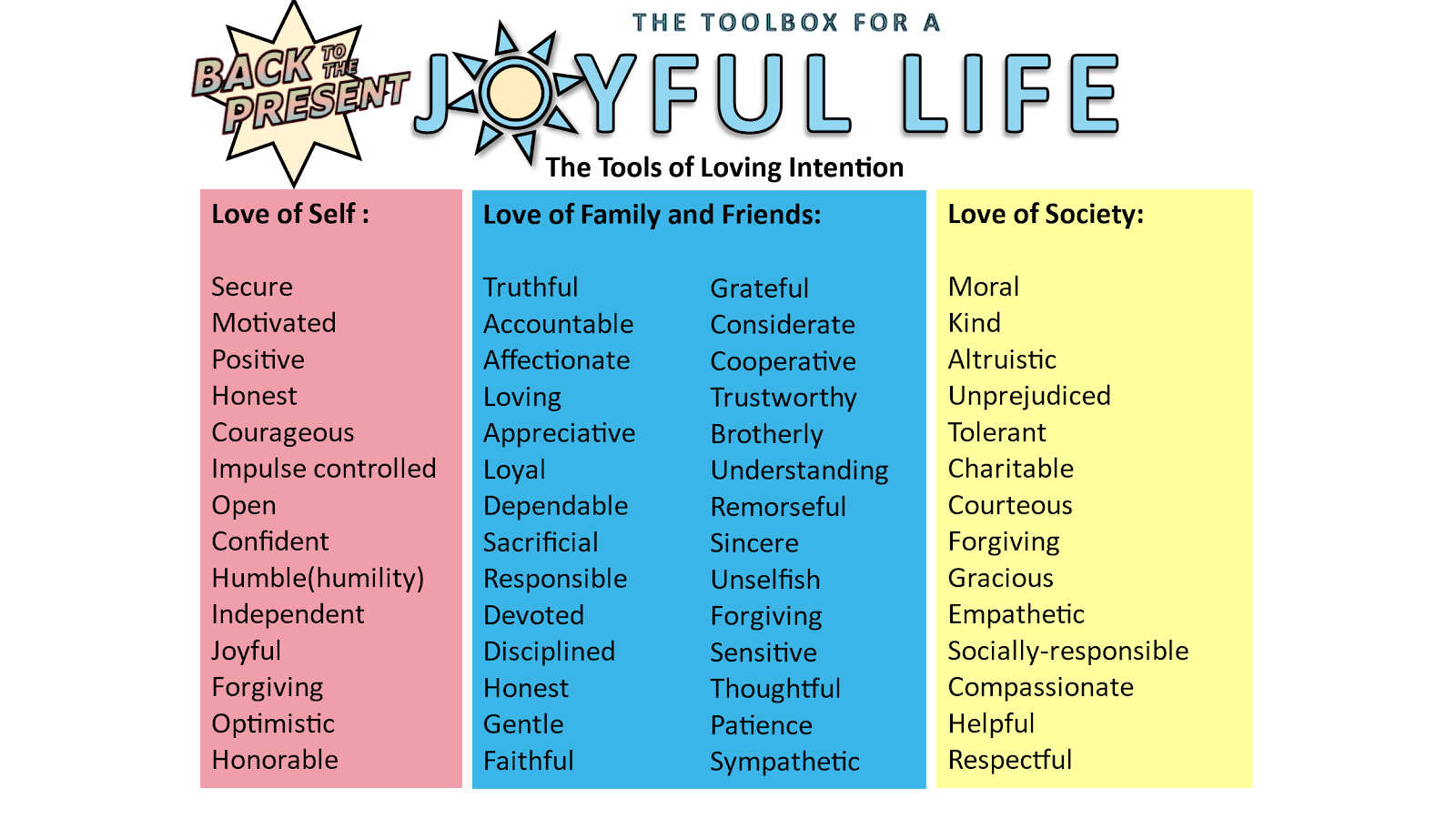
This activation appears to occur through early childhood observation, which is where the Toolbox for a Joyful Life exemplifies many (though not all) of the intuitive Sources of Knowledge (Figure -Toolbox for a Joyful Life-The Tools of Loving Intention). When young children witness others expressing these attributes with genuine joy and positive outcomes, it may trigger mirror neuron responses that help them access these innate capacities. Even in the earliest weeks of life, infants learn foundational social-emotional skills from caregivers, including how to communicate, express needs, and share emotions (Zero to Three, 2016). This suggests that these tools of loving intention are indeed "built into our subconscious mind," awaiting activation through the observation of authentic, joyful modeling, explaining why the quality of early relationships and the emotional tone of caregiving environments are so crucial in shaping our ability to access and express these deeper human capacities throughout life.
Reflective Question: Think about the adults who modeled joy and loving intention during your early years. Which of the four tools—communication, empathy, faith (trust), or sacrifice (nurturing care)—did you most often witness being expressed with genuine happiness? How do you see that early modeling showing up in your relationships today?
Exercise:
Memory Exploration: Close your eyes and recall a specific moment from childhood when you witnessed someone expressing one of these tools of loving intention with authentic joy—perhaps a parent comforting a friend, a teacher patiently helping a struggling student, or a grandparent showing unwavering faith in your abilities. Notice what you observed: their facial expressions, tone of voice, body language, and the positive outcome that followed.
Present-Day Reflection: Now consider how you express this same tool in your current relationships. Write down one recent example where you used this capacity. Did it feel natural or difficult? What might this tell you about how well that particular "tool" was activated in your early development?
Classroom/Group Version: In pairs, share a story of someone who modeled joyful loving intention during your childhood. Discuss which of the four tools they demonstrated and how witnessing their joy in expressing these qualities may have shaped your own capacity to access these same abilities today.
The Awakening: Our Three Gifts Take Flight
Humanity’s evolution turned when our Three Gifts—physical, emotional, and spiritual—were awakened into Awareness:
Our physical Gift gave us resilience, enabling us to live anywhere and eat almost anything.
Our emotional Gift allowed us to understand our feelings and recognize the feelings of others, making cooperation possible.
Our spiritual Gift opened access to thought and memory, granting us the power to reflect, imagine, and choose.
Together, these Gifts became the foundation for a life beyond survival. They taught us that every moment contains Manifestations—our actions, feelings, and thoughts—that reveal who we are becoming.
Reflective Question: Which of your three Gifts—physical, emotional, or spiritual—do you feel most called to strengthen right now?
Exercise:
Body-Mind-Spirit Check-In:
Physical: Stretch or walk mindfully, noticing how your body supports you.
Emotional: Pause and name your current feeling.
Spiritual: Write down one thought you’ve had today that gave you perspective or meaning.
Classroom Activity: Create a “Gifts Circle.” Each student shares how they recently used one of their Gifts.
Obligations and Agreements: Living with Awareness
Conscious Awareness and free choice brought responsibility. Humanity inherited Obligations:
Awareness of our actions, feelings, and thoughts, and the understanding of the impact on self and others,
Challenge to grow beyond impulses, knowing we could freely choose what we would like to do, feel, or think next.
Patience in choosing wisely, as we developed our physical, emotional, and spiritual Gifts to their greatest potential.
Honor in respecting our physical, emotional, and spiritual Gifts and each other.
These Obligations prepared the way for Agreements, commitments to live with productivity, peace, and purpose.
When honored, these Agreements transform the chaos of choice into a path of meaning.
Reflective Question: Which of the Obligations—Awareness, Challenge, Patience, or Honor—do you find most difficult to practice in your daily life?
Exercise:
Journaling Prompt: At the end of the day, write down one example where you practiced Awareness, Challenge, Patience, or Honor.
Mindfulness Practice: Choose one Obligation to focus on for a week. Each morning, set the intention: Today I will practice [Awareness/Challenge/Patience/Honor] in my choices.
The Story of Evan and Ava: A Metaphor for Awakening
Long ago, two wanderers, Evan and Ava, left their clans behind. Unlike their ancestors, they were no longer content with survival alone. Drawn by curiosity and longing, they discovered something new: they could live anywhere, eat anything, and, most importantly, choose their future.
Their journey revealed the power of their three Gifts, their Awareness of time and energy as Limited Resources, and their obligation to use them wisely. Together, they learned to balance their instincts, intellect, and intuition. They discovered the Tools of Loving intention, faith, empathy, communication, and sacrifice, and built a life rooted in trust, commitment, and purpose.
Their story is more than a tale. It is a mirror of humanity’s awakening into consciousness. It reminds us that, like them, we too are co-creators of the world we inherit and the world we leave behind.
Reflective Question: In what ways do you see yourself in Evan or Ava—longing for more than survival, seeking meaning through the choices you make?
Exercise:
Story Reflection: Write your own “Evan and Ava” moment — a time when you stepped into the unknown to grow beyond survival or comfort.
Classroom Activity: In pairs, share stories of times when intuition or faith guided you into a new direction.
Creative Evolution: Becoming Co-Creators
Today, humanity lives in the age of Creative Evolution. No longer bound only by natural selection or adaptive change, we consciously shape our future through choice.
We design families, communities, and societies based on intellectual and intuitive values.
We select partners not only for survival but for love, faith, and mutual growth.
We create technologies, cultures, and spiritual practices that reflect our deepest aspirations.
With every decision, we are shaping not only our lives but the genetic, cultural, and spiritual legacy of future generations.
Social experiments show that intuition often supports cooperation more effectively than deliberation (Capraro & Cococcioni, 2015). Likewise, frameworks in psychology suggest that integrating intellect with intuition produces better, values-based decisions (Adinolfi et al., 2022).
Reflective Question: What choices are you making today that will ripple into the lives of those who come after you?
Exercise:
Future Letter: Write a letter to a child, grandchild, or “future self,” describing how the choices you’re making now will shape their life.
Classroom Activity: Students create a “Legacy Board” where they draw or list the values and actions they want to pass down.
Conclusion: The Power of Presence
The story of human consciousness is not just a history—it is a guide for today. Our awakening reminds us that:
Needs bring contentment, wants promise happiness, but desires fulfilled through loving intention bring joy.
Instinct ensures survival, intellect improves life, but intuition connects us to love and purpose.
Time and energy are limited; every moment asks us to spend them wisely.
The question for each of us is simple: How will we use our Gifts, our Awareness, and our freedom of choice?
Like Evan and Ava, we stand in the Land of Awareness. The seeds we plant today—in our actions, feelings, and thoughts—will shape not only our lives but the future of humanity. Let us plant them with loving intention.
Reflective Question: If today were the beginning of a new chapter in your life, what seeds of action, feeling, or thought would you choose to plant?
Exercise:
Mindfulness Prompt: Imagine planting a seed in the soil. As you breathe, picture it growing into the life you want.
Journaling Prompt: Write: The seed I will plant today is… (action, feeling, or thought).