
Building Knowledge Through Experience
Purpose: Describing How Humans Store and Use Knowledge to Plan and Improve Their Lives
Human beings have a unique ability to store and utilize knowledge gained from experiences. This capability allows us to plan, make informed decisions, and continuously improve our lives. At backtothepresent.net, we emphasize the importance of understanding how our experiences shape our knowledge and guide our actions.
Key Points
Virtual Representation of Experience
The Role of Memory
Accessing Knowledge
Sources of Knowledge: Instinct, Intellect, and Intuition
Virtual Representation of Experience
Human experiences are stored as virtual representations in our memory. These representations include not only the factual details but also the associated emotions and sensory perceptions. This comprehensive storage system allows us to recall past experiences and apply the learned knowledge to new situations.
Key Aspects of Virtual Representation:
Comprehensive Storage: Experiences are stored with details, emotions, and sensory perceptions.
Holistic Recall: We can recall not just the facts, but the feelings and context of past experiences.
Real-Life Example: Think about a time you learned a valuable lesson from a mistake. You don’t just remember the error; you also remember how it made you feel and what you learned from it. This holistic recall helps you avoid similar mistakes in the future.
Practical Tips:
Reflect on Experiences: Take time to think about past experiences and what they taught you.
Document Lessons Learned: Keep a journal to record important insights and reflections.
Engage in Mindfulness: Practice mindfulness to enhance your ability to form and recall these virtual representations.
Engaging Question: Have you ever noticed how certain smells or sounds can instantly bring back a flood of memories? This is because our sensory perceptions are tightly linked to our emotional and factual memories.
The Role of Memory
Memory plays a crucial role in how we store and access knowledge. Our brains create and reinforce neural pathways each time we repeat an experience or reflect on it. This repetition strengthens our ability to recall and use the stored knowledge when needed.
Key Aspects of Memory:
Neural Pathways: Repetition strengthens the neural connections associated with specific experiences.
Procedural Memory: Actions and skills become more automatic with practice.
Emotional Memory: Strong emotions enhance the vividness and recall of memories.
Real-Life Example: A musician who practices regularly can perform complex pieces effortlessly. The repetition of practice creates strong neural pathways, making the performance feel natural and automatic.
Practical Tips:
Practice Regularly: Consistent practice helps reinforce memory and skill.
Use Sensory Cues: Incorporate smells, sounds, or visuals to strengthen memory recall.
Reflect and Repeat: Regularly revisit and reflect on important experiences to keep the memory fresh.
Engaging Question: How do you ensure that the skills you learn are retained effectively? Regular practice and reflection are key to embedding knowledge in memory.
Accessing Knowledge
Our ability to access stored knowledge is what sets humans apart. We can draw on past experiences and insights to navigate new challenges and make informed decisions. This capability allows us to create a life aligned with our goals and values.
Key Aspects of Accessing Knowledge:
Conscious Reflection: Deliberately thinking about past experiences to draw out lessons.
Intuitive Insight: Using gut feelings and intuition, which are informed by past experiences.
Strategic Planning: Applying stored knowledge to plan and achieve future goals.
Real-Life Example: An entrepreneur might use lessons learned from past business ventures to guide new projects. Each decision is informed by accumulated knowledge, leading to better strategic choices.
Practical Tips:
Reflect Regularly: Schedule time for regular reflection on past experiences.
Consult Your Intuition: Trust your gut feelings, as they are informed by past knowledge.
Plan Strategically: Use your insights and lessons learned to plan and achieve your goals.
Engaging Question: How often do you use past experiences to make decisions about your future? This reflective practice is a powerful tool for shaping your life.
Sources of Knowledge: Instinct, Intellect, and Intuition
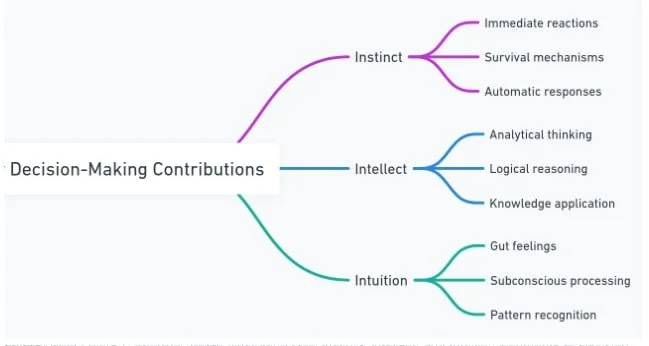
Humans have three primary sources of knowledge that guide our decision-making processes: instinct, intellect, and intuition.
Instinct:
Definition: Instinctual knowledge is the inherent understanding we are born with, helping us react to immediate situations without conscious thought.
Role: It is essential for survival, guiding us through basic needs and responses.
Example: Instinctively pulling your hand away from a hot surface.
Intellect:
Definition: Intellectual knowledge is acquired through learning and reasoning. It involves understanding facts, concepts, and information.
Role: It helps us solve problems, analyze situations, and make logical decisions.
Example: Using mathematical principles to solve a complex problem.
Intuition:
Definition: Intuitive knowledge is the ability to understand or know something without conscious reasoning, often described as a "gut feeling."
Role: It guides us in making decisions based on experiences and subconscious insights.
Example: Sensing that a business decision is right despite not having all the data.
Engaging Question:
How do you balance instinct, intellect, and intuition when making decisions? Each source of knowledge plays a unique role in shaping our actions and outcomes.
Practical Tips:
Trust Your Instincts: Recognize when instinctual responses are guiding you effectively.
Develop Your Intellect: Continuously learn and seek knowledge to strengthen your intellectual decision-making.
Hone Your Intuition: Pay attention to your gut feelings and reflect on past experiences to better understand your intuitive insights.
Call to Action
Understanding how we build and access knowledge through experience is crucial for personal growth and informed decision-making. By harnessing this capability, we can shape our lives in meaningful ways. Visit backtothepresent.net to explore more about how to leverage your experiences to build a more mindful, productive, and purposeful life.
By focusing on the unique ability to store and access knowledge, we can improve our lives and the world around us. Let backtothepresent.net guide you in this journey of continuous learning and growth.